Frequency
Frequency is the number of occurrences of a repeating event per unit of time. It is also occasionally referred to as temporal frequency for clarity and to distinguish it from spatial frequency. Frequency is measured in hertz (Hz) which is equal to one event per second. Ordinary frequency is related to angular frequency (in radians per second) by a scaling factor of 2π. The period is the interval of time between events, so the period is the reciprocal of the frequency.
For example, if a heart beats at a frequency of 120 times a minute (2 hertz), the period, T—the interval at which the beats repeat—is half a second (60 seconds divided by 120 beats). Frequency is an important parameter used in science and engineering to specify the rate of oscillatory and vibratory phenomena, such as mechanical vibrations, audio signals (sound), radio waves, and light.
For cyclical phenomena such as oscillations, waves, or for examples of simple harmonic motion, the term frequency is defined as the number of cycles or repetitions per unit of time. The conventional symbol for frequency is f; the Greek letter ν (nu) is also used. The period T is the time taken to complete one cycle of an oscillation or rotation. The relation between the frequency and the period is given by the equation:
f = 1/T
The term temporal frequency is used to emphasise that the frequency is characterised by the number of occurrences of a repeating event per unit time.
Bandwidth
Bandwidth is the difference between the upper and lower frequencies in a continuous band of frequencies. It is typically measured in hertz, and depending on context, may specifically refer to passband bandwidth or baseband bandwidth. Passband bandwidth is the difference between the upper and lower cutoff frequencies of, for example, a band-pass filter, a communication channel, or a signal spectrum. Baseband bandwidth applies to a low-pass filter or baseband signal; the bandwidth is equal to its upper cutoff frequency.
Bandwidth in hertz is a central concept in many fields, including electronics, information theory, digital communications, radio communications, signal processing, and spectroscopy and is one of the determinants of the capacity of a given communication channel.
A key characteristic of bandwidth is that any band of a given width can carry the same amount of information, regardless of where that band is located in the frequency spectrum. For example, a 3 kHz band can carry a telephone conversation whether that band is at baseband (as in a POTS telephone line) or modulated to some higher frequency. However, wide bandwidths are easier to obtain and process at higher frequencies because the Fractional bandwidth is smaller.
Gain
In electronics, gain is a measure of the ability of a two-port circuit (often an amplifier) to increase the power or amplitude of a signal from the input to the output port by adding energy converted from some power supply to the signal. It is usually defined as the mean ratio of the signal amplitude or power at the output port to the amplitude or power at the input port. It is often expressed using the logarithmic decibel (dB) units ("dB gain"). A gain greater than one (greater than zero dB), that is amplification, is the defining property of an active component or circuit, while a passive circuit will have a gain of less than one.
Antenna Gain or 'absolute gain' is defined as "The ratio of the radiation intensity in a given direction to the radiation intensity that would be produced if the power accepted by the antenna were isotropically radiated".
Bits and Bytes
The bit is the most basic unit of information in computing and digital communications. The name is a portmanteau of binary digit. The bit represents a logical state with one of two possible values. These values are most commonly represented as either "1" or "0", but other representations such as true/false, yes/no, on/off, or +/− are also widely used.
The relation between these values and the physical states of the underlying storage or device is a matter of convention, and different assignments may be used even within the same device or program. It may be physically implemented with a two-state device.
A contiguous group of binary digits is commonly called a bit string, a bit vector, or a single-dimensional (or multi-dimensional) bit array. A group of eight bits is called one byte, but historically the size of the byte is not strictly defined. Frequently, half, full, double and quadruple words consist of a number of bytes which is a low power of two. A string of four bits is a nibble.
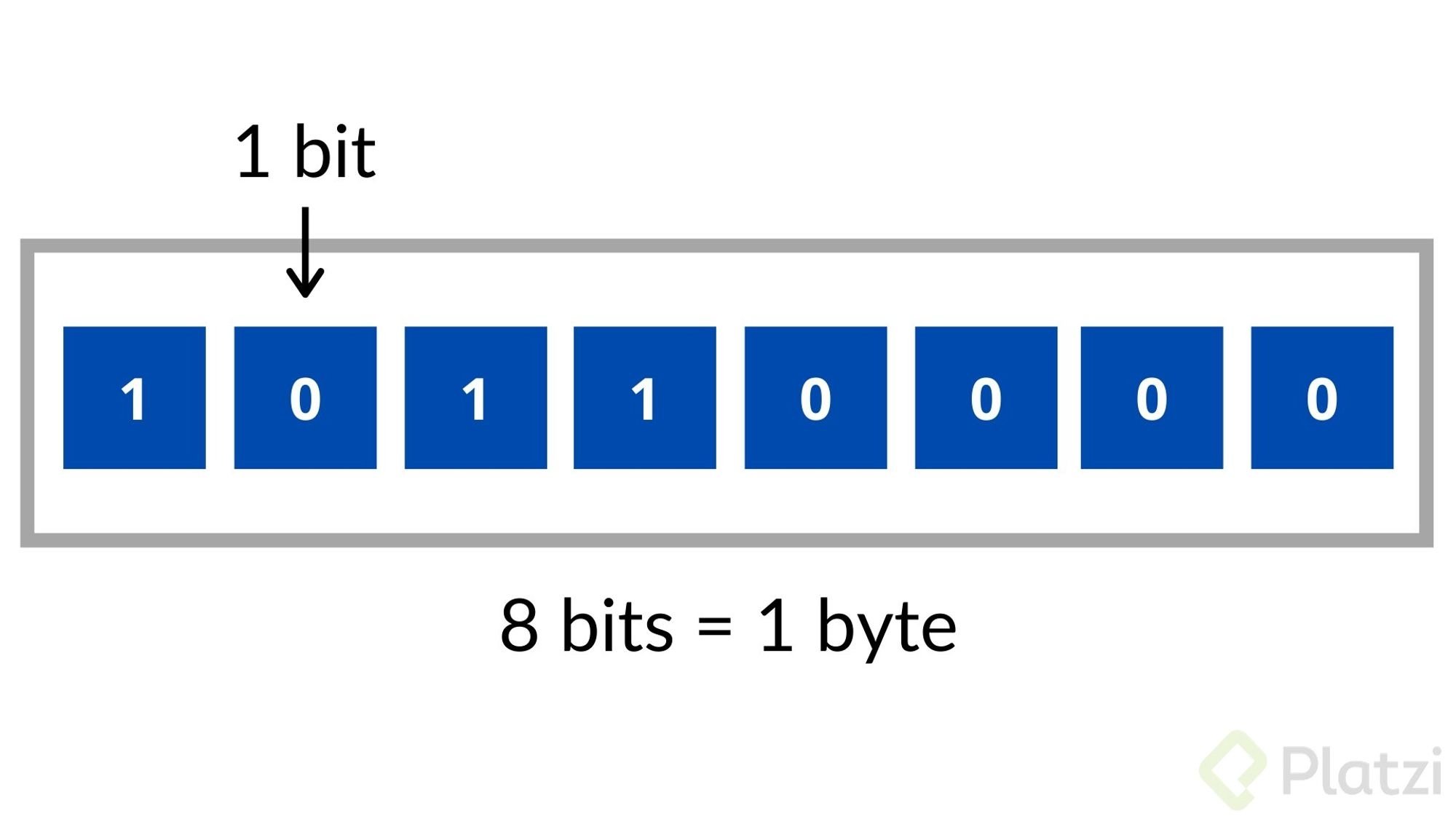
The byte is a unit of digital information that most commonly consists of eight bits. Historically, the byte was the number of bits used to encode a single character of text in a computer and for this reason it is the smallest addressable unit of memory in many computer architectures. To disambiguate arbitrarily sized bytes from the common 8-bit definition, network protocol documents such as the Internet Protocol (RFC 791) refer to an 8-bit byte as an octet. Those bits in an octet are usually counted with numbering from 0 to 7 or 7 to 0 depending on the bit endianness. The first bit is number 0, making the eighth bit number 7.
The size of the byte has historically been hardware-dependent and no definitive standards existed that mandated the size. Sizes from 1 to 48 bits have been used. The six-bit character code was an often-used implementation in early encoding systems, and computers using six-bit and nine-bit bytes were common in the 1960s. These systems often had memory words of 12, 18, 24, 30, 36, 48, or 60 bits, corresponding to 2, 3, 4, 5, 6, 8, or 10 six-bit bytes. In this era, bit groupings in the instruction stream were often referred to as syllables or slab, before the term byte became common.
Wireless Technologies

The most common wireless technologies use radio waves. With radio waves, intended distances can be short, such as a few meters for Bluetooth or as far as millions of kilometers for deep-space radio communications. It encompasses various types of fixed, mobile, and portable applications, including two-way radios, cellular telephones, personal digital assistants (PDAs), and wireless networking. Other examples of applications of radio wireless technology include GPS units, garage door openers, wireless computer mouse, keyboards and headsets, headphones, radio receivers, satellite television, broadcast television and cordless telephones. Somewhat less common methods of achieving wireless communications involve other electromagnetic phenomena, such as light and magnetic or electric fields, or the use of sound.